The science of extraction.
Drop by drop.
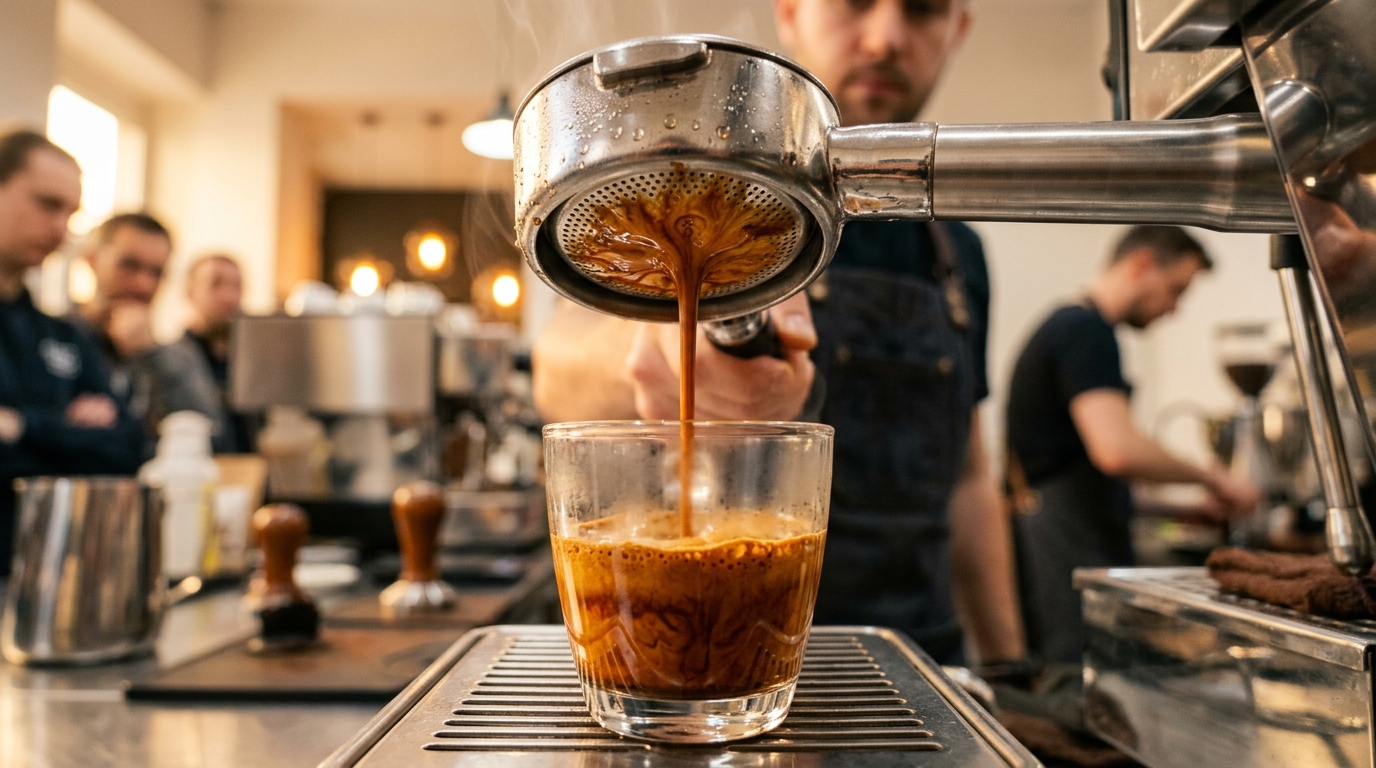
Espresso brewing is high-pressure thermal fluid dynamics where physics meets aromatic alchemy. Discover the 5 fundamental pillars of a perfect shot.
Barista Formula
The 5 variables of perfect balance.
Each parameter shifts the extraction rate of coffee solubles (acids, sugars, lipids, and bitterness).
The Dose (Ground Coffee)
The exact weight of ground coffee loaded into your portafilter basket. A variance of just 0.5 grams alters water flow resistance and shot duration.
The Liquid Yield
The weight of liquid espresso extracted in the cup. For an 18g dose, target 36g of liquid espresso. This is the golden standard ratio for balanced flavor.
Brewing Time
Shot timer started when the pump activates. Under 22s = under-extracted (sour/thin); over 32s = over-extracted (harsh/bitter).
Water Temperature
Ideal water temperature ranges from 90°C to 94°C. At 90°C, you highlight fruity acidity in light roasts. At 94°C, you extract body in dark roasts. Electronic PID controllers (Breville, Miele) eliminate thermal dips during brewing.
Optimal Pressure
9 bars of atmospheric pressure (~130 PSI) is the exact force needed to emulsify soluble coffee lipids without over-compressing fine grounds. An Over-Pressure Valve (OPV) maintains this peak limit.
Low-pressure pre-infusion: the anti-channeling shield.
Before applying full 9-bar pressure, pre-infusion gently saturates the coffee puck with low pressure (2 to 3 bars) for 5 to 8 seconds. This swells grounds evenly, sealing micro-fractures where high-pressure water would otherwise stream rapidly (causing destructive channeling).
Without Pre-infusion
Sudden 9-bar impact creates preferential channels. Result: shots tasting both sour and harsh simultaneously.
With Pre-infusion
Homogeneous puck saturation. Uniform resistance across the shower screen yields a thick, syrupy extraction.
Precision Technique
Puck Prep: the pro barista routine.
Achieve perfectly repeatable extractions shot after shot using this 3-step puck prep routine.
WDT Tool Distribution
Use a Weiss Distribution Technique tool (0.3mm fine needles) to declump coffee grounds in the basket for uniform density distribution.
Surface Leveling
Level the top of the coffee bed horizontally without downward pressure prior to tamping, preventing density gradients.
Level Tamping
Tamp firmly with a flat tamper precision-fitted to your basket (54mm or 58mm). Levelness matters far more than raw tamping force.
Water chemistry: optimal mineral balance.
Pure distilled or reverse osmosis water without minerals yields flat, intensely sour espresso. Water needs dissolved minerals to bind with coffee aroma compounds.
Target TDS (120–150 ppm)
Total Dissolved Solids recommended by the Specialty Coffee Association (SCA).
Magnesium vs Calcium
Magnesium binds fruity and complex flavor compounds. Calcium adds body but forms limescale.
Troubleshooting Matrix
Barista diagnostic guide (6 Scenarios).
Identify extraction anomalies quickly and apply instant barista fixes.
Fast Flow & Sour Taste (Under-extraction)
Symptom: 36g espresso extracted in under 18 seconds. Pale crema dissipating fast.
➜ Fix: Adjust grinder 1-2 steps finer or increase dose by 0.5g-1g.
Choking & Bitter Taste (Over-extraction)
Symptom: Water barely drips (> 35s). Dark crema with black spot. Harsh burnt flavor.
➜ Fix: Adjust grinder coarser or decrease dose by 0.5g.
Side Spraying & Squirts (Channeling)
Symptom: Water jets spraying sideways on bottomless portafilter. Taste is both sour and astringent.
➜ Fix: Use WDT tool to declump grounds evenly and check tamper levelness.
Completely Thin Crema Layer
Symptom: Shot looks like drip coffee without silky foam layer.
➜ Fix: Coffee beans are stale (CO2 gas depleted)! Switch to fresh roasts (< 30 days post-roast).
Inconsistent Cup Temperature
Symptom: First shot lukewarm, second shot scalding hot.
➜ Fix: Preheat portafilter and cup with an empty hot water flush before dosing.
Soggy & Muddy Spent Coffee Puck
Symptom: Watery mud stuck to shower screen upon removing portafilter.
➜ Fix: Basket under-dosed (excessive headroom above puck). Increase dose by 1g.
Ready for the next step?
Learn how to select the right coffee beans for your machine and palate.
Chapter 02: Coffee Beans Selection →